
The afternoon heat in Chinatown always feels a little different than the rest of the city. It presses down on the narrow streets, trapping the heavy, comforting scent of roasted nuts, caramelized sugar, and baked lard under the shaded walkways.
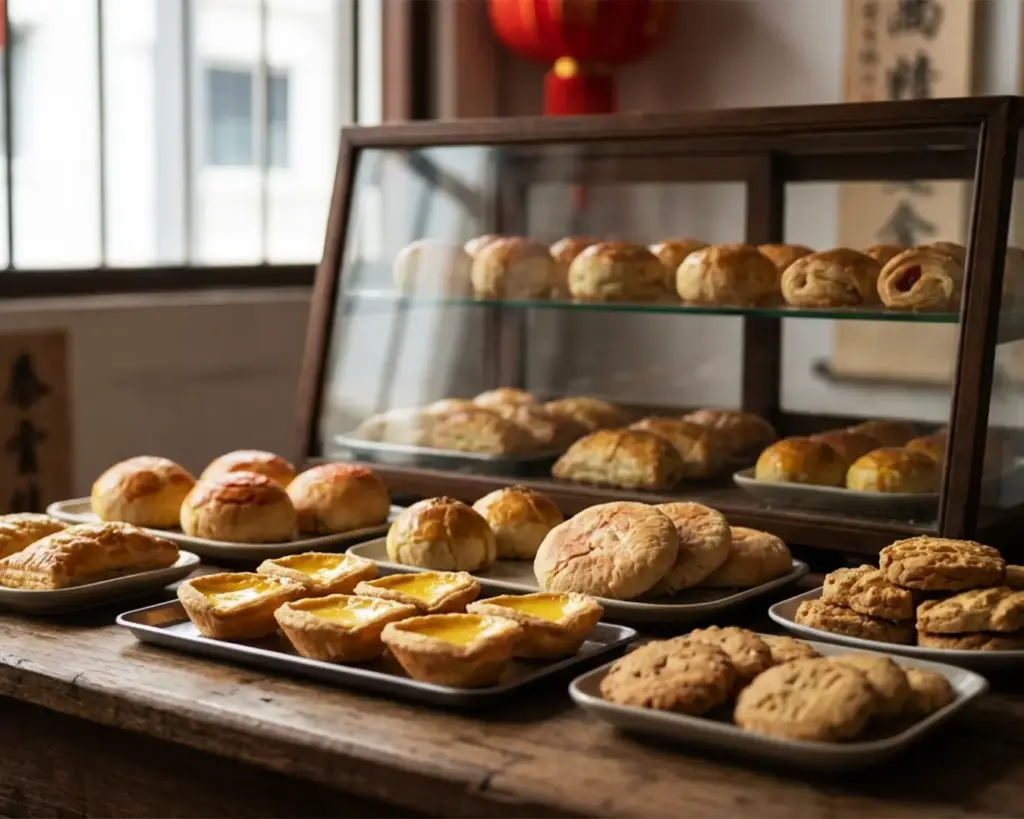
I step out of the bright, glaring sun and into the cool, tiled shadow of a traditional bakery. Behind the scratched glass counter, neat rows of pastries sit on wire cooling racks.
They do not demand attention. There are no bright artificial colors, no elaborate garnishes, and no loud signs. They are just pale, golden-brown domes, quietly resting on small squares of translucent parchment paper.
Inside the shop, the air is thick with the warm, toasted aroma of sesame and the sweet, earthy scent of lotus paste. The environment hums with a quiet, practiced focus. Behind the counter, I can see a glimpse of the back kitchen, where flour dusts the large wooden tables. The bakers move with a steady, unhurried rhythm, completely detached from the frantic rush of the pedestrians outside the window. I ask for a single mung bean pastry.
The woman behind the counter slips it into a small paper bag, handing it to me with a brief, gentle nod. The paper bag is still warm against the palm of my hand.
When you look at a traditional Chinese pastry, you see an object of absolute simplicity. It is a humble circle of baked dough, plain and entirely unadorned. It fits perfectly in the center of your palm. Yet, the moment you take a bite, that initial illusion of simplicity instantly falls away.
The crust does not just break; it shatters. It separates into dozens of paper-thin, microscopic layers that dissolve the moment they meet your tongue. Beneath that incredibly delicate exterior lies the filling—a dense, smooth paste of mung beans. It is perfectly balanced between savory and sweet, carrying just a faint, lingering whisper of fried shallots.
In my own work, I spend a lot of time thinking about how stories are constructed. The most powerful narratives often appear completely straightforward on the surface. You watch a quiet conversation unfold on a screen, and it feels entirely natural, almost effortless. But beneath that single, quiet moment lies a massive, hidden architecture of choices—lighting, pacing, subtle script revisions, and years of practiced acting.
The humble pastry in my hand holds the exact same kind of hidden architecture. To achieve that effortless, flaky crust, a baker must perform an incredibly complex, repetitive physical dance. They must carefully fold a water-based dough around an oil-based dough, rolling and flattening the mixture over and over again.
If the room is too hot, the oil melts. If the rolling hand is too heavy, the delicate layers crush together and ruin the texture. It requires a quiet, physical intuition that simply cannot be rushed or faked.
We often confuse the simple with the easy. We walk past these narrow bakery windows every single day, assuming the treats inside are just quick, cheap fuel to get us through a busy afternoon. We rarely stop to consider the staggering amount of human skill and generational knowledge folded into every single piece. Food, at its very best, is a physical record of patience.
I finish the last crumb of the pastry, gently brushing the stray flakes from my shirt. The street outside is still loud, crowded, and moving entirely too fast. But for a brief moment, standing in the quiet shade of the bakery, I feel completely grounded.
It is a beautiful reminder that we can always find unexpected depth in the smallest details, if we only take the time to notice. Sometimes, the most complex stories are the ones we can hold right in the palm of our hand.