
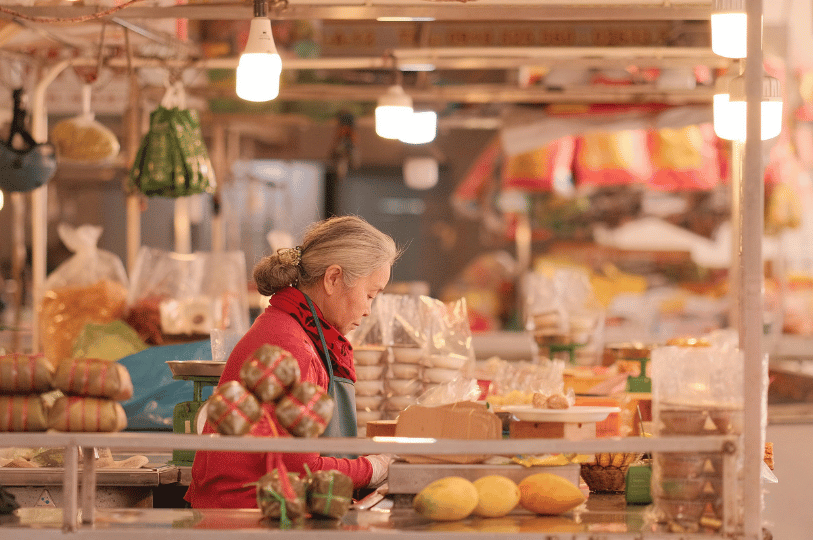
When we observe a high-volume food center during the midday rush, the disparity between neighboring vendors becomes immediately quantifiable. On one side of the aisle, a line of twenty people extends outward, requiring customers to navigate around fixed seating. Directly adjacent, another stall remains entirely empty.
The owner stands idle behind a display case of pre-cooked dishes. We often attribute this gap to a simple difference in taste. However, a closer look at the mechanics of hawker operations reveals that stall longevity depends on a strict combination of consistency, pricing, and physical placement.
The baseline requirement for survival is operational consistency. At the thriving stall, you notice that the workflow is highly systematized. The vendor measures the dark soy sauce with a specific ladle. They time the boiling of noodles to the exact second. This standardization ensures that a customer receives the precise same profile and portion size on a Tuesday as they do on a Friday.
At the empty stall, variations in batch cooking often lead to a high degree of product inconsistency. When consumers cannot predict the quality of their meal, their return rate drops sharply.
Pricing models also dictate foot traffic. In this environment, value perception is highly sensitive. A price increase of fifty cents might seem negligible in a restaurant setting, but here, it fundamentally shifts consumer behavior. Vendors who successfully maintain their customer base often absorb minor supply chain cost increases or adjust their component ratios slightly rather than altering the final display price. They understand that crossing a specific price threshold forces the buyer to re-evaluate the transaction entirely.
Finally, physical location plays a measurable role in a stall’s lifespan. Corner units and stalls facing main pedestrian arteries benefit from immediate visual capture. Customers walking in from the street often join the first visible queue that aligns with their dietary preferences.
Stalls located in the inner rows or near the back exits must work significantly harder to draw traffic, relying heavily on destination dining rather than impulse consumption.
Ultimately, keeping a stall open requires more than adequate recipes. It demands strict inventory control, precise location mapping, and a rigid adherence to routine.
The stalls that remain operational for decades are those that successfully manage these physical and economic variables day after day.